
FTC Compliance for Affiliates: Audit Your Old Posts in 2026
Old social posts are still endorsements you are using, and the FTC says keeping them accurate is your obligation. Deleting one moves no legal date. Export your archive, grade every income claim against your company's own disclosure, then fix in place and delete last.
You want to know whether the things you posted years ago can still land on you.
They can. Just not for the reason most people assume…
Disclosure: I am a Redact affiliate and a paying customer, and I get paid if you buy through my link. Which is exactly why I have been careful to say where the free tools do the job better. Which is most of the time.
The Warning Went Out in 2020. April 2026 Was the Follow-Through.
Six years ago the FTC settled with five affiliate marketers who promoted a business coaching scheme called MOBE.
Not the owners. The people sending traffic to it.
Andrew Smith, then running the Bureau of Consumer Protection, said this in the release of 5 March 2020, and I have never seen it quoted anywhere in this industry:
“Affiliates should take note that the FTC will hold you personally and financially accountable for false or unsubstantiated marketing claims.”
Nobody listened. I did not either.
Then April 2026. The agency described what it was doing in its own release of 27 April 2026:
“This is the second case in the past month where the Commission has taken action against high-level MLM participants for making deceptive earnings claims.”
Second case in a month. Stormy Wellington over Total Life Changes and Farmasi, then Steven and Gina Merritt over LifeWave. Both closed by stipulated order, and neither company sat at the defense table.
The mechanism fits in one sentence. Take what the promoter said, put the company’s own published income numbers beside it, and let the gap do the arguing. LifeWave’s 2024 disclosure had 79% of active participants earning nothing in commissions. Gina Merritt was on video promising to help people make $25,000 a week.
Nobody had to prove that impossible. They only had to print both.
And if you sell software or courses rather than shakes, read that 2020 quote again. It does not contain the word MLM.
Are Your Old Posts Still a Live Problem?
Yes, and here is the sentence that decides it. The FTC’s endorsement guidance, in the revision stamped June 2023 and checked again on 24 August 2026, says this:
“If you’re using endorsements that are a few years old, it’s your obligation to make sure the claims still are accurate.”
Your obligation. Not the company’s, not the platform’s. A post from 2019 that is still public is still an endorsement you are using.
So how do you tell a live problem from an old post you can leave alone? Three tests, and a claim has to pass all three.
| The test | What passing looks like | What most old posts do |
|---|---|---|
| Was it true, and can you produce the proof today | A statement, a screenshot, a dated record you can put your hand on this week | Nothing. The evidence was a feeling in 2019 and it is a memory now |
| Is the source and the date sitting in the post itself | “My own back office, March 2026,” written into the sentence | “I know people who” and “studies show,” which substantiate nothing |
| Does the typical result sit beside the figure at the same size | The company’s own median, in the same paragraph, in the same size type | The median is missing, or buried in a footer nobody clicks. Mine is on its own page |
Fail one and the claim is a problem. Everything after this is how to apply that at volume.
How Long Does the FTC Have to Come After You?
Roughly five years from the day you posted, and deleting the post does not move that date by an hour.
Five years is the catch-all limitations period on a government penalty action. When those five years begin was the whole question in Gabelli v. SEC, and the answer, from which no justice dissented, ties the clock to the wrongdoing rather than to the day an agency notices it. The opinion borrows a line I think about a lot:
“even wrongdoers are entitled to assume that their sins may be forgotten”
Chief Justice Roberts wrote that quoting Wilson v. Garcia, 1985.
So the 2018 post is largely behind you.
Good.
Here is what is not, and this is the distinction almost every page on this subject blurs. The clock runs from the act, and reposting is a new act. So is boosting with ad spend, pinning it to the top of your profile, dropping the link in a group chat, or sending a prospect to it this afternoon.
A dormant post nobody is pointed at is old evidence. A five-year-old post you are still recruiting with is current conduct wearing an old date stamp.
Federal exposure is also only one lane. State consumer protection statutes run their own clocks, mostly two to four years: California’s unfair competition law gives four, Texas two with a discovery rule bolted on.
Then Georgia, in a category of its own. Under O.C.G.A. 16-12-38, participating in a pyramid promotional scheme is a misdemeanor of a high and aggravated nature, and establishing or promoting one is a felony carrying one to five years. The statute defines promote to include inducing another person to become a participant. Read the carve-out for a compliant multilevel distribution company before you panic. But the section exists, and I have never once heard it mentioned in this industry.
What Happens If It Lands on You?
The fine is not the scary part.
Civil penalties top out at $53,088 per violation, a figure set in the Federal Register on 17 January 2025 and unchanged since, because the 2026 inflation adjustment was canceled when the shutdown killed the CPI data it runs on. In the MOBE affiliate cases the judgments ran to tens of millions, most of it suspended for inability to pay, and about $4.5 million actually changed hands across five people.
The terms are.
The Merritts agreed they may not say anything about what a participant can expect to earn unless they can substantiate it in writing at the moment the claim is made, and hand that evidence to anyone who asks about joining.
Read that again. The condition is not that the claim be true. It is that the paperwork exist, in writing, before you speak. Wellington’s order works the same way and stacks years of reporting on top.
The real cost.
Not a check. A permanent condition on how you may talk about money, in a business that runs entirely on how you talk about money.
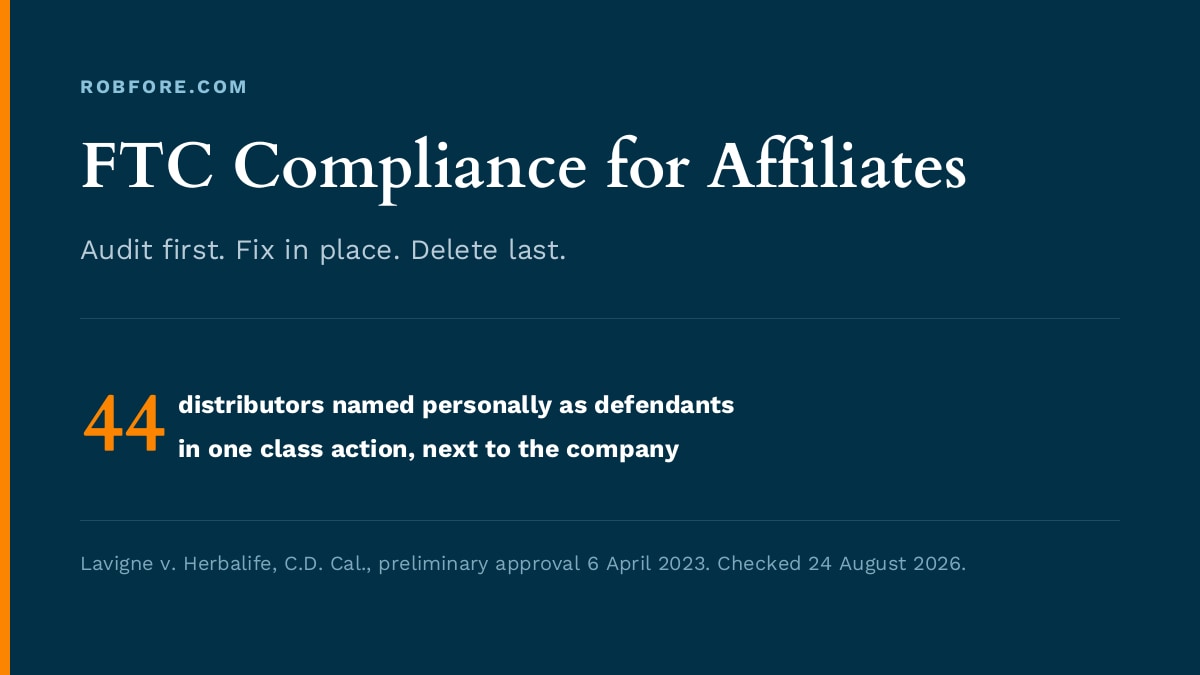
Underneath that sits a civil layer nobody warns you about. In Lavigne v. Herbalife, 44 high-ranking distributors were named as defendants next to the company. Herbalife funded the whole $12.5 million settlement itself and the distributors’ parallel case was dismissed as a term of that deal, so I cannot tell you any of them wrote a check. What I can tell you is that 44 people spent five years as named defendants in federal court over things said at events.
And do not assume the rules aimed at companies stop short of you. The consumer reviews rule at 16 CFR Part 465, effective 21 October 2024, defines a business as an individual who sells products or services.
Can AI Tell You Which Posts Are the Problem?
It can, and here is the problem it solves. You cannot search your own history.
Ask Facebook, Instagram or YouTube to show you every post of yours containing a dollar figure. There is no such control on any of them, and the third-party tools that do search match whole words only, so “income” misses “incomes.”
Which leaves reading. Fifteen years of your own posts, one at a time, and you will not finish.
Your archive is one request away, though: Download Your Information on Facebook, Takeout on Google, Your X Data on X. Ask for all three now, because they arrive on their own schedule. Then hand the files to a model with a rubric rather than a question.
Here is mine, so you know what you are walking into.
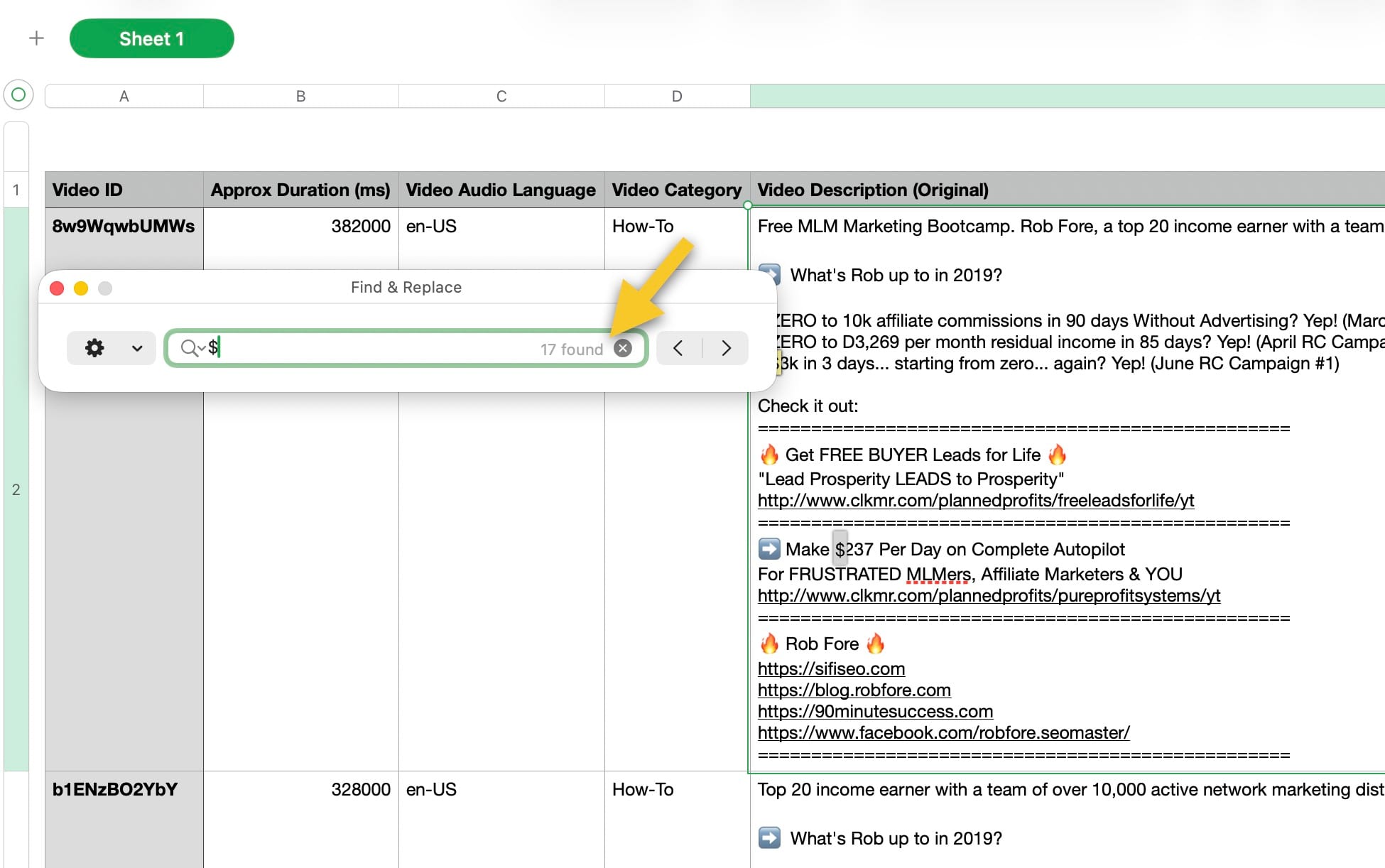
Seventeen dollar signs in one description. A top 20 income earner. Two hundred and thirty-seven dollars a day on complete autopilot. Zero to ten thousand in ninety days.
No source on any of it, no date, and nowhere on that page the one number that decides everything: what the typical person in those programs actually made. It has a page of its own here now.
I wrote every word of it. It sat in public for seven years.
Prompt one. The denominator test.
Attached: a dated export of everything I have published, plus the most recent income disclosure from [COMPANY NAME]. Go through the export item by item. Wherever a post states or implies what somebody can earn, output a row with the date, the platform, my exact words, the figure or outcome an ordinary reader would take away from them, and the matching number from the disclosure. Score the distance between those last two as NONE, MODERATE or WIDE. Treat near-duplicates as separate rows. Work in batches if you need to and keep going until you reach the end of the file.
That is the enforcement theory from both April 2026 filings, pointed at your own timeline. A WIDE row is the shape of the conduct those orders were written about.
What About the Claims You Never Put a Number On?
Those are the dangerous ones, and there is a second prompt for them.
Prompt two. The implication sweep.
Same export. Now ignore dollar figures entirely and find claims made by implication. Flag: photos or mentions of vehicles, houses, travel or purchases connected to the business; rank advancement announcements; screenshots of any dashboard, notification or deposit; phrases about firing a boss, replacing an income, working from a beach or time freedom; any timeline at all, including "in my first month"; hypothetical math using product prices; and testimonials from people in my downline. For each, quote my exact words and state in one sentence what an ordinary reader would conclude about earnings.
Anyone can search an archive for a dollar sign. Almost NOBODY audits their own timeline for implication.
Look at what the Merritt order actually forbids. It bars misrepresenting earnings “expressly or by implication, including through images of homes, vehicles, purchases, or travel,” which I read on the FTC’s own case page on 24 August 2026. There is not one word about a dollar figure in that sentence. A photograph of a car with a rank caption under it is the conduct.
Your screenshots have a second problem your sentences do not, and it is invisible. They carry a date, and nothing on the page states it.
I found a YouTube achievement card in my own files reading “Your channel is 15 years old today!” That channel opened in August 2008, which puts the capture in August 2023. Nothing printed on the image says 2023.
Nothing near it did either.
Now imagine that card is a commission screen instead. Put a three-year-old dashboard in a post you refreshed last month and every reader takes the number as current, because nothing tells them otherwise.
So would a regulator. The picture is a representation you are making today, whatever day you made it.
So caption every capture with the date you took it, in words, beside the image, the way the export screenshot further up this page is captioned. A screenshot whose date you cannot establish does not go back up at all.
A flagged item you want to argue with is the one to look at hardest. That reflex is why implication works on people in the first place.
What Do You Do With the Ones You Cannot Delete?
You find out whether you can defend them, and only then touch the wording. That order is not arbitrary.
The standard is not whether your number was true. It is whether you had a reasonable basis at the moment you said it, and whether you can put your hand on the evidence now. The FTC’s multi-level marketing guidance, says a reasonable basis means reliable empirical evidence rather than subjective belief or personal anecdote.
So the last prompt runs in two passes, proof before prose.
Prompt three. Substantiate, then rewrite.
Work through the flagged list in two passes. Pass one: for each item, name the exact document I would have to produce today to support it, and where that document would come from. Where no such document could exist, mark it UNSUPPORTABLE and stop there. Pass two: for everything that survived pass one, write a replacement I can paste in. Keep my voice and keep the post's original point. Remove the earnings claim, or keep the figure only if you add the source, the date and the typical participant result in the same sentence at the same size. Never use the word guaranteed about income, results or timelines. Never state or imply how long anything takes. Give me two columns, original and replacement, and a separate list of everything marked UNSUPPORTABLE.
An UNSUPPORTABLE row is not a wording problem. Your answer about that post, already given.
Fix, Edit, Delete or Call Counsel?
This is a garage cleanout, not a demolition. Most of what is back there is fine, and the job is sorting it into piles rather than backing a truck up to the door.
| What the audit found | What to do | Why |
|---|---|---|
| A dollar figure with no source, no date and no typical result beside it | Edit in place | The sentence is the problem, not the post. Keep the date |
| Vehicle, house or travel photos tied to the business | Delete | Both April 2026 orders name images specifically. There is no compliant caption |
| A link to a program that folded | Swap the link, keep the post | That is a trust problem rather than a legal one, and it is the cheapest fix here |
| Genuine teaching with one bad sentence in it | Edit the sentence only | The most common case, and the one people over-correct into deleting good work |
| Hypothetical commission math | Edit, add the qualifier and the denominator | Arithmetic is still a claim. Arithmetic beside the median is not |
| Anything at all, once a letter arrives | Stop. Preserve everything. Call a lawyer | The one bucket with no judgment call in it |
The tools matter far less than the sorting, and the best ones are free.
The one that costs people the most time is the one you just looked at. YouTube Studio cannot search inside your descriptions, and Takeout can, because the metadata export puts every description in a spreadsheet column. Studio’s bulk editor will then strip an exact phrase out of hundreds of video descriptions in one pass, free.
One warning, because the mistake is irreversible and not obvious.
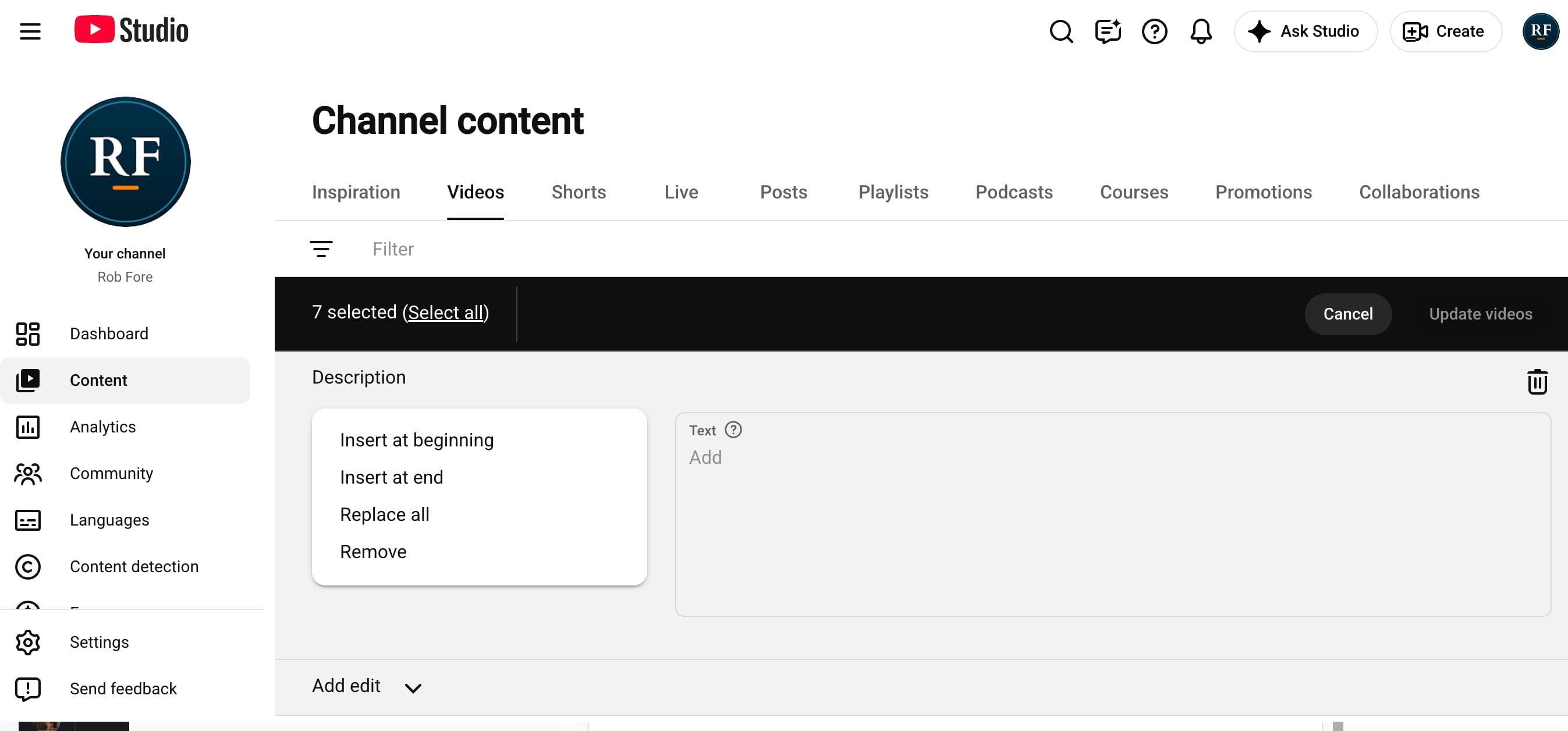
Replace all overwrites the entire description of every video you selected. Not find and replace. Remove takes out only your text and leaves the rest standing. They sit two lines apart and nothing on that screen tells you which is which.
The free route covers most people completely, and I would rather say that than sell you something. Money starts making sense at volume, for one capability: swapping the words in a post instead of destroying it. Prompt three hands you a column of replacement text, and at four hundred items you are not pasting that in by hand.
Redact sells that on Premium, and it is the one paid thing on this page.
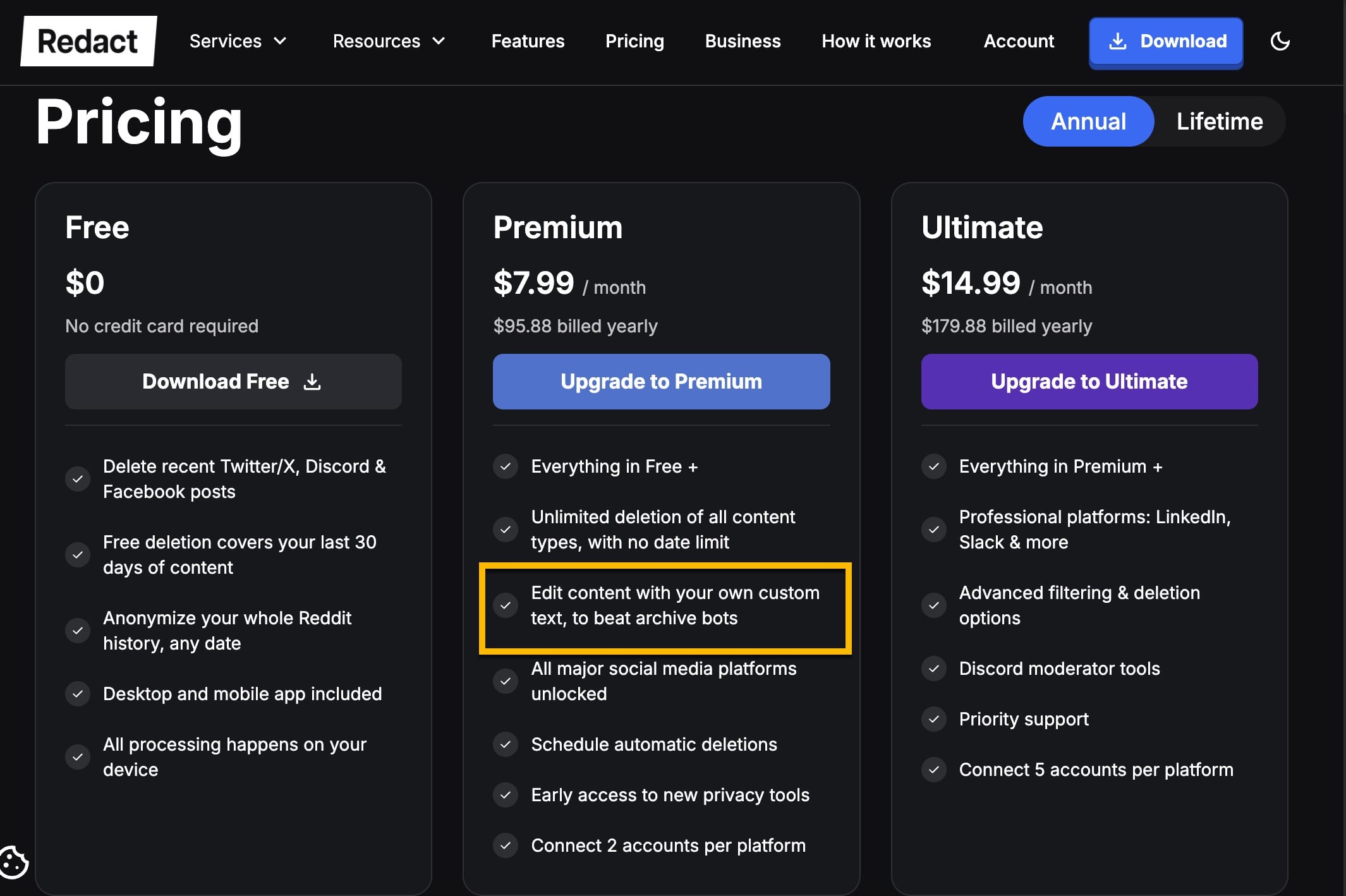
Read what it got wrong when I ran three of my own accounts through it before you spend anything.
I Am Not A Lawyer, And Here Is What Else
Start with the disqualification, because it is the important one.
I am not a lawyer and I am not close. Thirty years of operating, read against the FTC’s own documents.
Something official already in your hands? Close the tab and call one.
The clock analysis is the honest version rather than the frightening one. No authority says a post that merely sits there restarts a limitations period, and I am not inventing one to make this land harder. Which cuts both ways: some of your exposure has already expired and you will never know which.
I cannot tell you where reasonable anticipation begins. In FTC v. Noland, an MLM case, the court called a coordinated deletion “an outrageous maneuver that raises a strong inference of bad faith” and granted an adverse inference. FTC guidance published 19 January 2018 is blunt about what a civil investigative demand triggers: you “must stop any routine procedures that would destroy documents that could reasonably relate to the investigation.” Where the line sits before that letter arrives is a lawyer’s call, not mine.
And I did not follow this advice on my own biggest asset. My YouTube channel published 346 videos and showed six publicly on 24 August 2026, with the last of those coming off once the new ones start. That was a rebuild decision rather than a compliance one, but it cost me exactly what this page tells you to protect: eighteen years of timestamped proof I was doing this long before the people now selling courses about it. Weigh me against that.
And there is no earnings claims rule, whatever anybody told you. The government’s own regulatory agenda, records that the Commission “publicly released, but never published in the Federal Register, a Notice of Proposed Rulemaking on January 13, 2025,” and the action sits at the prerule stage today. So anyone selling you a compliance course on the basis that these are law is selling you something. Every action on this page happened under authority the FTC already had.
What Does the First Hour Look Like?
Notice that none of the archive work happens in it. The archive is a week away. Your profile is not.
- Minutes one to ten. Look at yourself the way a prospect does. Logged out, on a phone. Your pinned post, your bio, the first three things visible. That surface costs you deals today and it needs no export at all.
- Minutes ten to twenty-five. Run the three tests on what you just saw. By hand, out loud if it helps. Most people find one item in that handful failing all three, and fixing it is worth more than the whole cleanup behind it.
- Minutes twenty-five to forty. Find your company’s current median. Pull the income disclosure and write the number down. Every prompt here is useless without it, and learning to read one properly pays for itself next time somebody pitches you.
- Minutes forty to fifty. Open a substantiation folder. Dated screenshots, nothing clever. From today, evidence goes in before the claim goes out. This is the only step that changes what you publish tomorrow.
- Minutes fifty to sixty. Request the exports. If your channel sits on a Brand Account, switch into it first or the videos silently will not be in the file, and you find that out two days later.
- Then stop and wait. The prompts are an evening’s work once the files land, and whether you need a tool is a decision you make holding a list.
Read Your Own Archive Before Somebody Else Does
Most of this industry treats compliance as something you bolt on at the end, in eight-point gray type, hoping nobody reads it.
I went through my own video descriptions one at a time, by hand, because I wanted to read what was in them before anything moved. I would do the reading again tomorrow. The clicking I would not, and a free bulk editor sat two clicks away the whole afternoon.
Which is the entire page. The reading is the work, and nobody can do that part for you.
Do it anyway. Not because a regulator is coming for you this quarter, but because the operators still standing after thirty years are the ones who name the cost before the upside and the failure rate before the plan. That is the only version that survives somebody who has already been burned twice, and the channels this business runs on are full of those people now.
Your archive will not read itself.
Go and get the export.
Bless and be blessed,

Sources
- FTC Business Guidance Concerning Multi-Level Marketing, January 2018, revised April 2024 - checked Aug 24, 2026
- FTC's Endorsement Guides: What People Are Asking, revision stamped June 2023 - checked Aug 24, 2026
- FTC: Affiliate Marketers to Pay More Than $4 Million to Settle Charges, 5 March 2020 - checked Aug 24, 2026
- FTC action against a high-level MLM participant (Wellington), 13 April 2026 - checked Aug 24, 2026
- FTC action against high-level MLM participants (Merritt / LifeWave), 27 April 2026 - checked Aug 24, 2026
- Unified Agenda RIN 3084-AB70, Earnings Claims Trade Regulation Rule, prerule stage - checked Aug 24, 2026
- Adjustments to Civil Penalty Amounts, 90 FR 5580, 17 January 2025 - checked Aug 24, 2026
- 16 CFR Part 465, Rule on the Use of Consumer Reviews and Testimonials, effective 21 October 2024 - checked Aug 24, 2026
- Gabelli v. SEC, 568 U.S. 442 (2013) - checked Aug 24, 2026
- FTC Bureau of Consumer Protection: So You Received a CID, 19 January 2018 - checked Aug 24, 2026
- FTC v. Noland, order granting spoliation sanctions, D. Ariz. 2:20-cv-00047, 30 August 2021 - checked Aug 24, 2026
- Lavigne v. Herbalife, C.D. Cal. 2:18-cv-07480, $12.5m settlement, preliminary approval 6 April 2023 - checked Aug 24, 2026
- O.C.G.A. 16-12-38, pyramid promotional schemes - checked Aug 24, 2026
- California Business and Professions Code 17208, four-year limitation - checked Aug 24, 2026
- Redact pricing - checked Aug 24, 2026
- Google Data Portability schema reference, YouTube - checked Aug 24, 2026
- YouTube Help, edit multiple videos at once - checked Aug 24, 2026
- My own Google Takeout export of my YouTube data, one search across every video description - checked Aug 24, 2026